
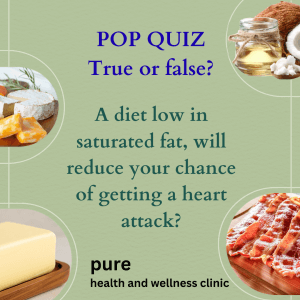
For years, saturated fats have been labelled as one of the main “villains” of heart health. Many public health guidelines still recommend lowering saturated fat intake to reduce the risk of heart disease. But surprisingly, these recommendations come mostly from observational studies, not from controlled clinical trials.
“This blog summarises findings from a 2023 systematic review and meta-analysis published in a peer-reviewed journal.”
The findings may challenge what many people thought they knew..
Let’s break it down in a simple, practical way.
What Did the Researchers Study?
This study looked at nine randomized controlled trials, involving more than 13,500 people. These trials compared two groups:
- People who reduced their saturated fat intake
- People who continued their usual diets
Researchers then examined whether reducing saturated fat actually lowered:
- Cardiovascular mortality
- All-cause mortality
- Heart attacks
- Coronary artery events
Importantly, older methods such as ECG or angiography findings were excluded to keep the results fair and objective.
What Did the Study Find?
Here’s the surprising part:
Reducing saturated fat intake did not significantly change the risk of:
- Cardiovascular death
- Death from any cause
- Heart attacks
- Coronary events
The relative risk numbers hovered very close to 1.0, showing no meaningful differences between the groups.
And in the case of stroke, the researchers couldn’t even evaluate the data because not enough cases were reported across the studies.
So… Should We Stop Worrying About Saturated Fat?
This study suggests that simply cutting saturated fat on its own is not enough to prevent heart disease or reduce mortality.
But here’s the important part:
The authors also highlight that most trials were conducted decades ago — before modern medical care and before widespread use of statins. So more updated studies are still needed.
So instead of focusing narrowly on a single nutrient, a more holistic approach is often far more meaningful.
A Whole-Person Approach to Heart Health
At Pure Health & Wellness Clinic, we look at the body as an interconnected system. Heart health is influenced by:
- Diet quality as a whole (not one nutrient)
- Stress levels and emotional wellbeing
- Physical activity
- Sleep quality
- Gut and metabolic health
- Inflammation
- Genetics and personal history
This is why two people can eat the same foods yet experience completely different health outcomes.
Rather than fearing saturated fats, we help clients build a balanced, sustainable approach to eating — one that supports energy, metabolism, mood, and long-term cardiovascular health.
Key Takeaways for Everyday Life
Here’s what this research means for the average person:
- Saturated fats alone are not the deciding factor in heart health.
- Quality matters: Whole foods behave differently in the body compared to processed foods.
- Balance is key: A nutritious diet includes a mix of healthy fats, whole grains, lean proteins, fibre-rich plants, and antioxidants.
- Lifestyle has a major impact: Managing stress, improving sleep, and staying active play huge roles in heart function.
In short — you’re not defined by one nutrient. You’re defined by your overall habits and your unique body.
References
- 2023 Systematic Review & Meta-analysis on saturated fat reduction and cardiovascular disease (https://pubmed.ncbi.nlm.nih.gov/40416032/)